
What the 12,000 comparisons showed
The study separates two groups. In 520 baseline profiles, the original fixed payment reached payoff within the 1,200-month calculation horizon. Those profiles support direct comparisons of months and interest saved. The remaining 80 baseline profiles didn't have a payoff path at the original payment, so they're analyzed as payment-threshold cases.
Every profile has the same weight. These percentages describe the defined study grid. They don't estimate how often the same balance, APR, or payment pattern occurs among real cardholders.
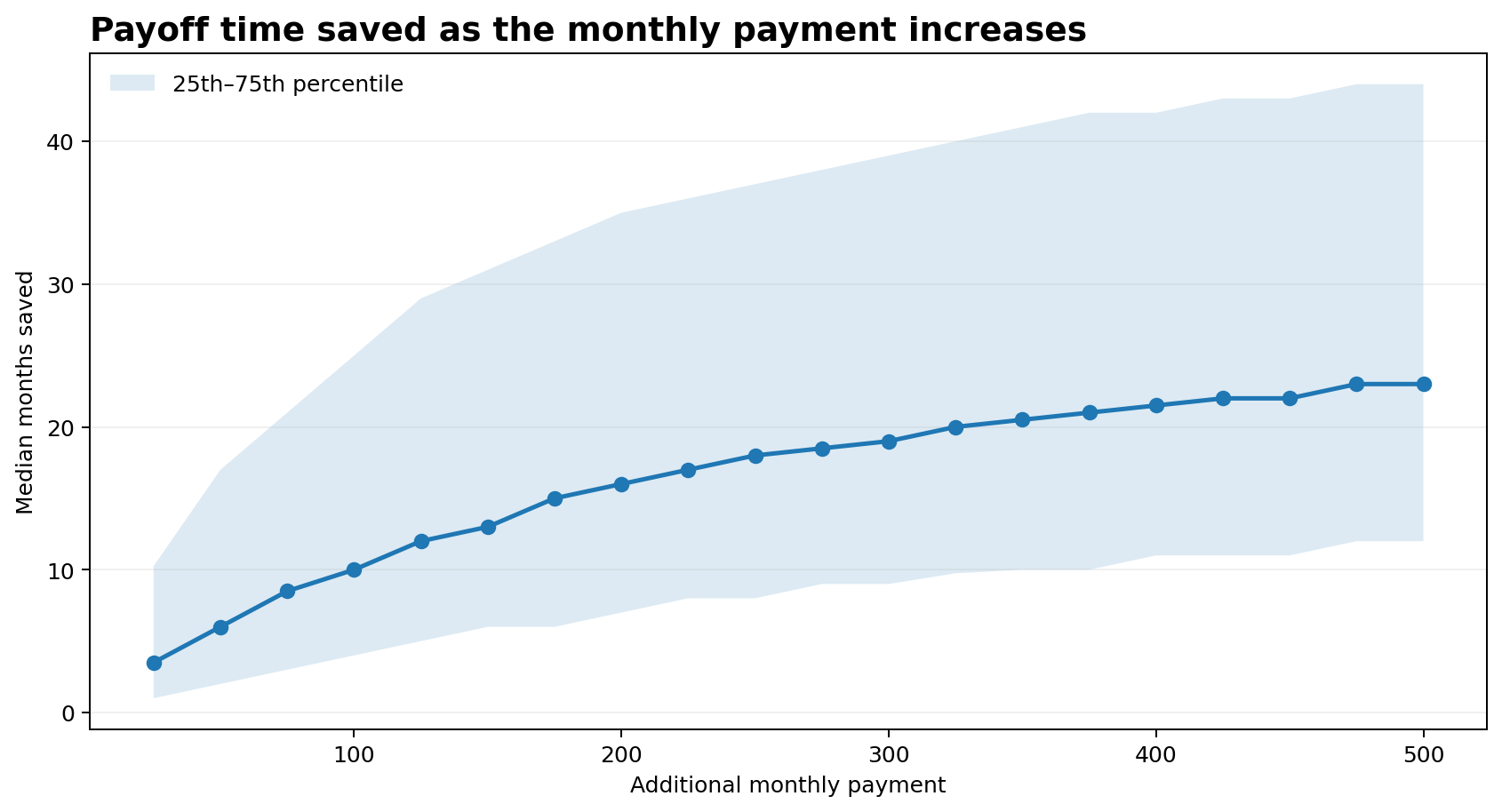
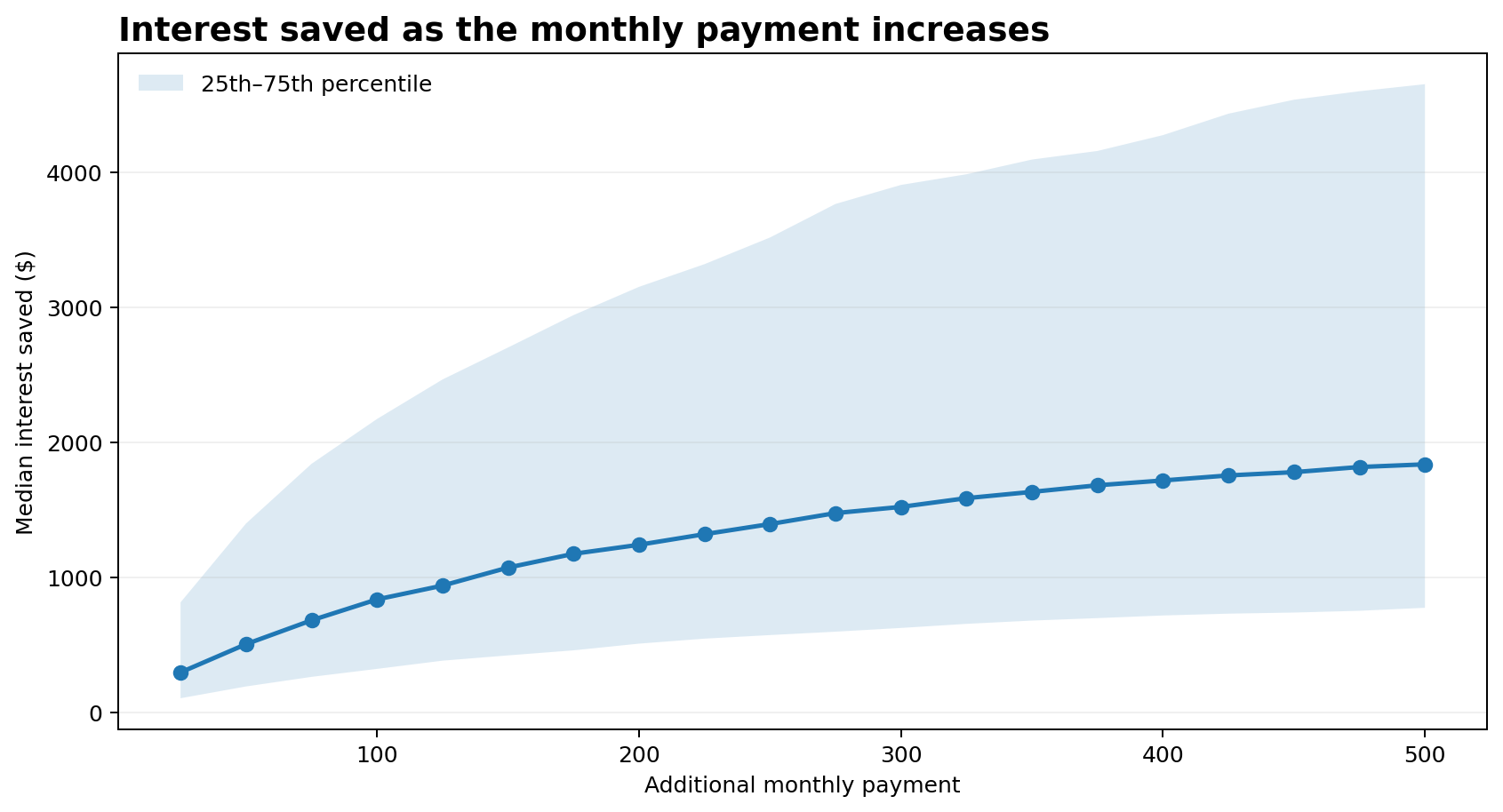
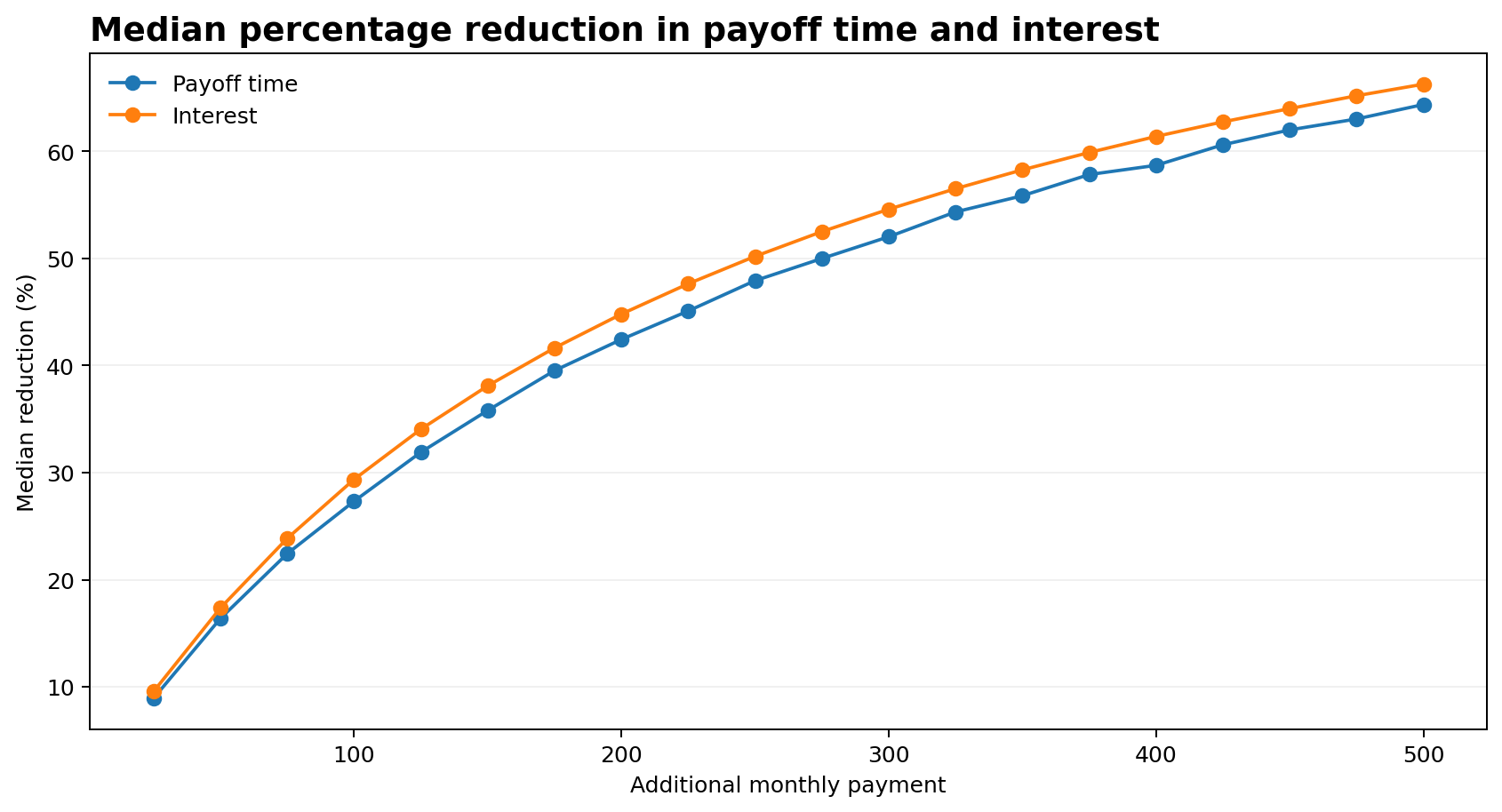
| Extra each month | Median months saved | Median interest saved | Median payoff-time reduction | Median interest reduction |
|---|---|---|---|---|
| $25 | 3.5 | $295.05 | 8.93% | 9.56% |
| $100 | 10 | $835.42 | 27.33% | 29.37% |
| $200 | 16 | $1,239.73 | 42.44% | 44.81% |
| $500 | 23 | $1,835.31 | 64.38% | 66.28% |
The table uses the 520 baseline profiles where both the original payment and the higher payment reached payoff.
What we tested
We created 600 baseline credit-card profiles and tested 20 higher-payment versions of each profile. Every defined combination appears once.
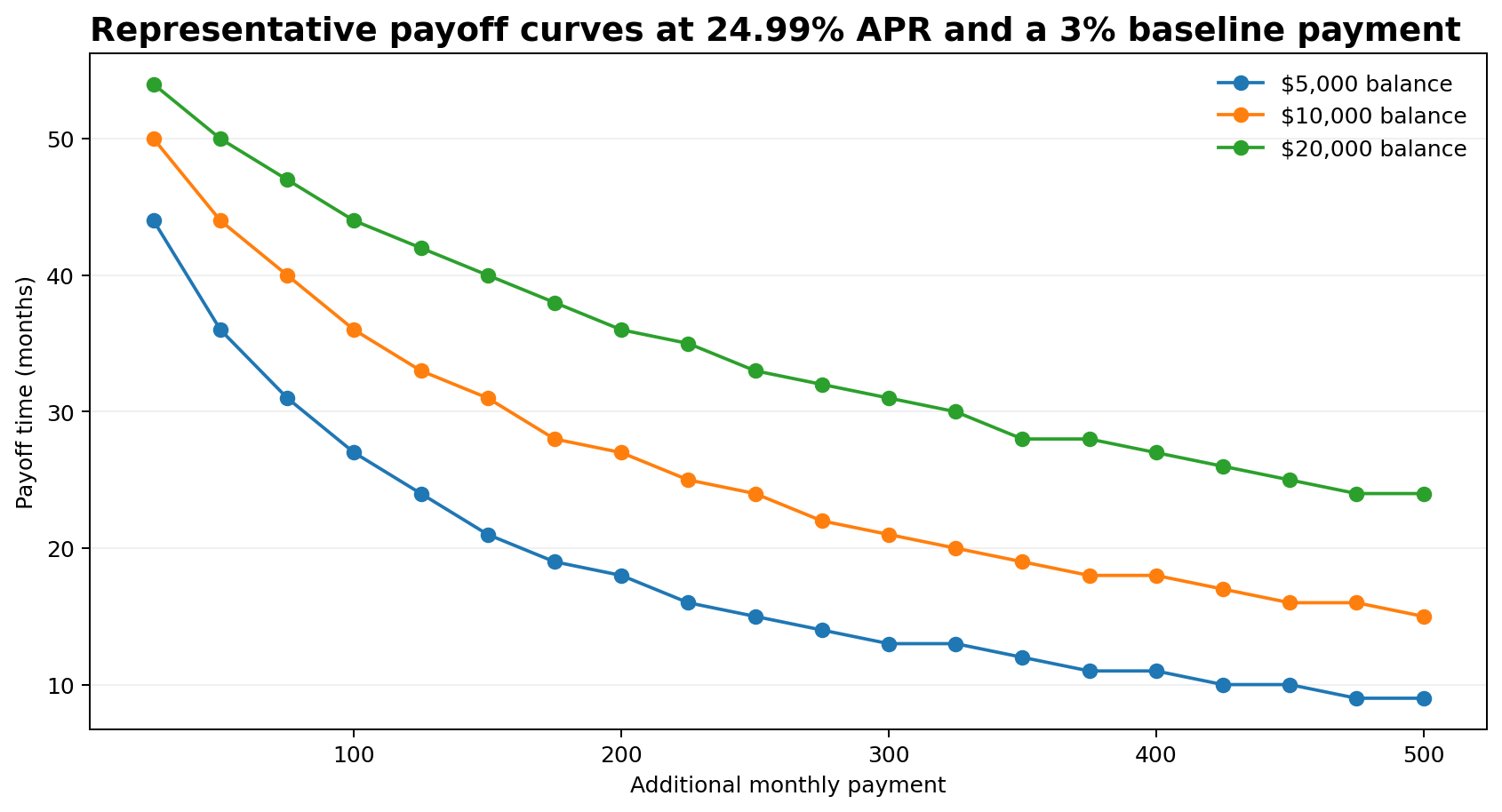
The payment-rate percentage is used once to establish a fixed dollar payment. It doesn't decline as the balance falls. For example, a 3% baseline payment on a $10,000 starting balance is a fixed $300 per month.
The first extra $25 had a wide range of effects
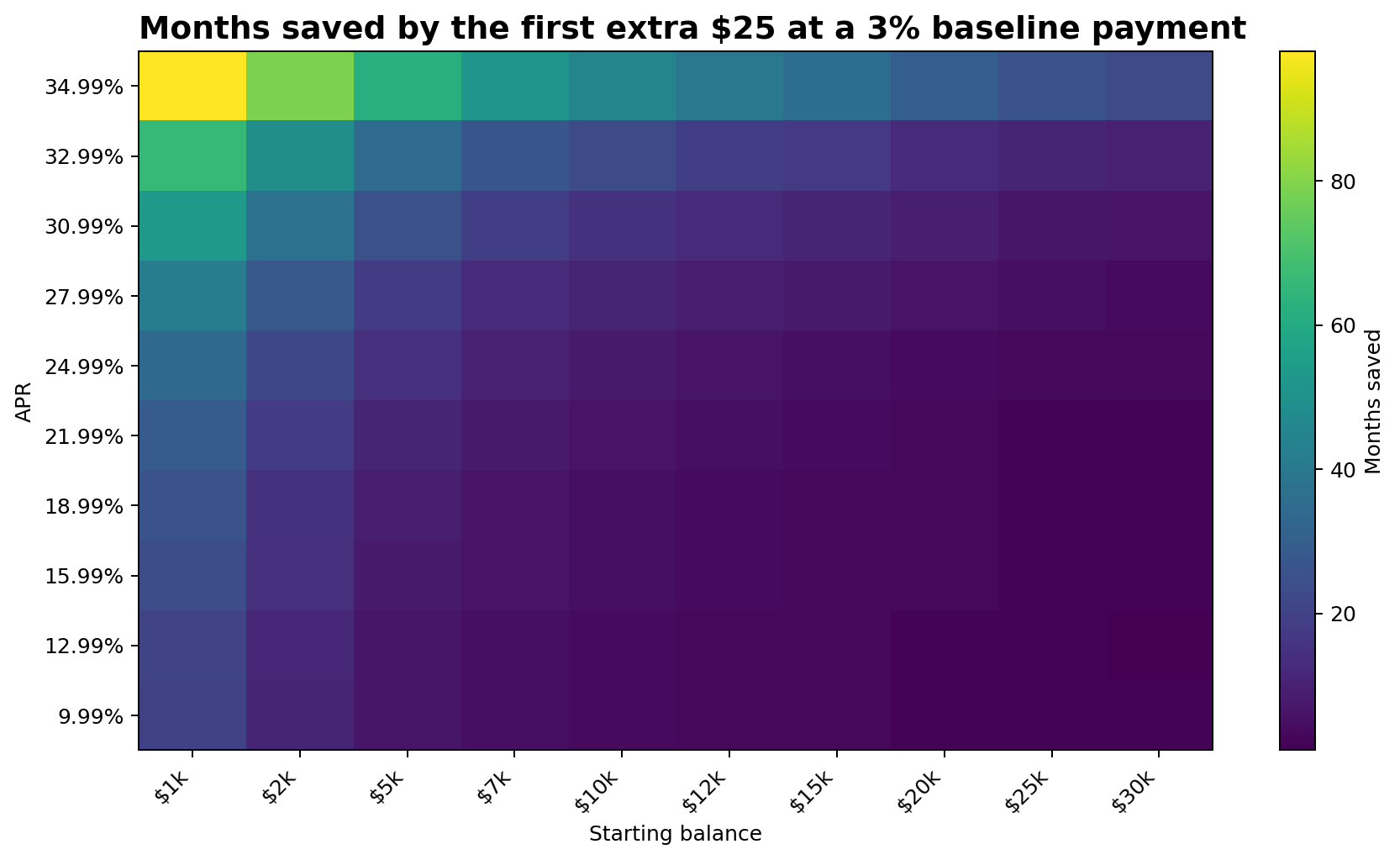
Among the 520 finite baselines, +$25 saved at least one month in 478 profiles, or 91.92%. It saved at least 12 months in 120 profiles, or 23.08%.
The original payment level was a major separator. Among finite profiles starting at a fixed payment equal to 2% of the original balance, +$25 saved a median 17.5 months and $1,288.53 of interest. Among profiles starting at 7.5%, the medians were 1 month and $59.98.
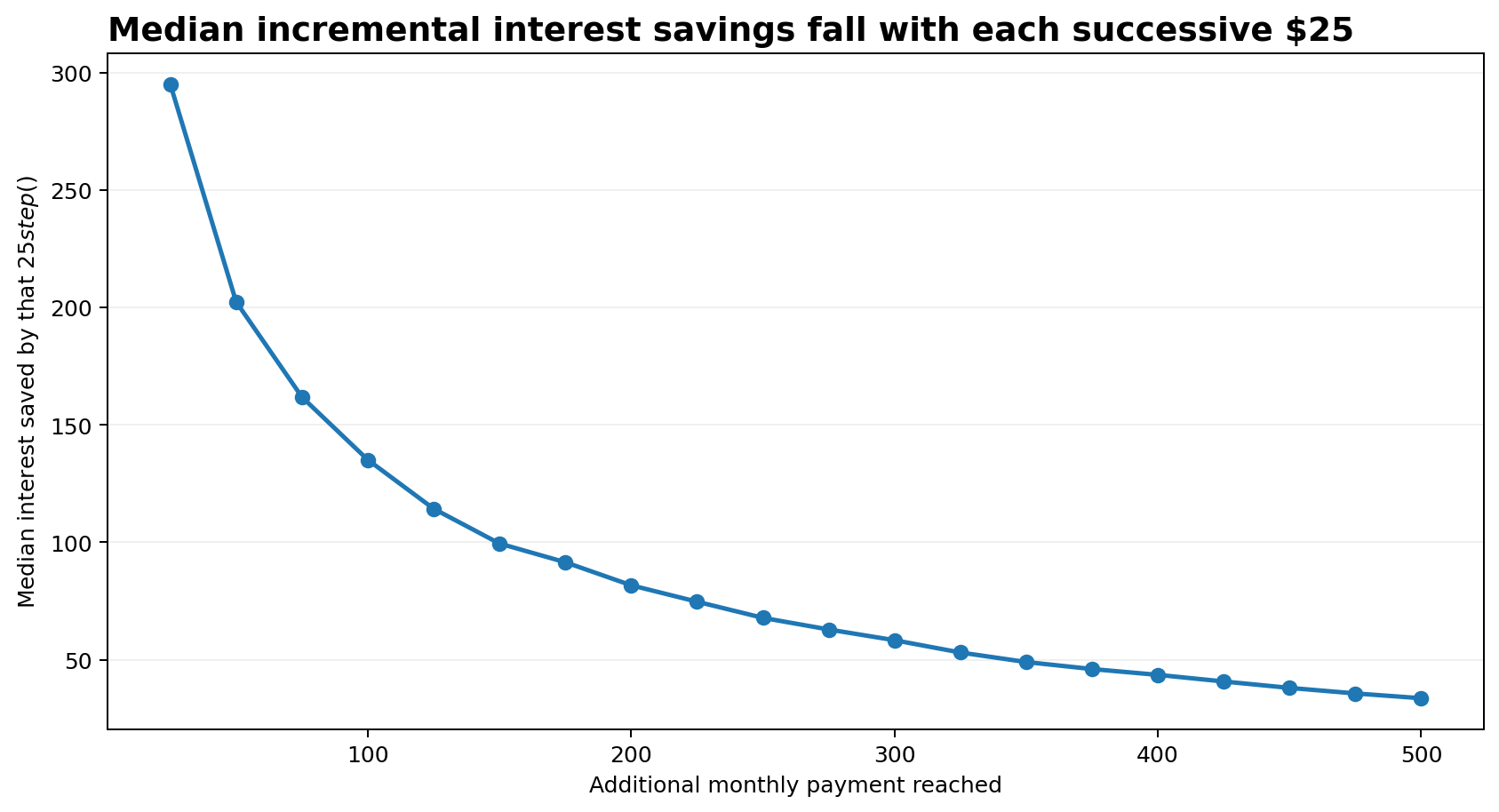
Median incremental interest savings fell with each successive $25
The first $25 cut median interest by $295.05. The next $25, moving from +$25 to +$50, produced a median additional reduction of $202.39. By the step from +$475 to +$500, the median incremental interest reduction was $33.63.
Payoff time moves in whole months, so the marginal month benefit becomes especially uneven at higher payments. By the +$400 step, the median incremental change in payoff time was 0 months even though many individual profiles still improved and interest continued to fall.
For some low-payment profiles, $25 changed the payoff from undefined to finite
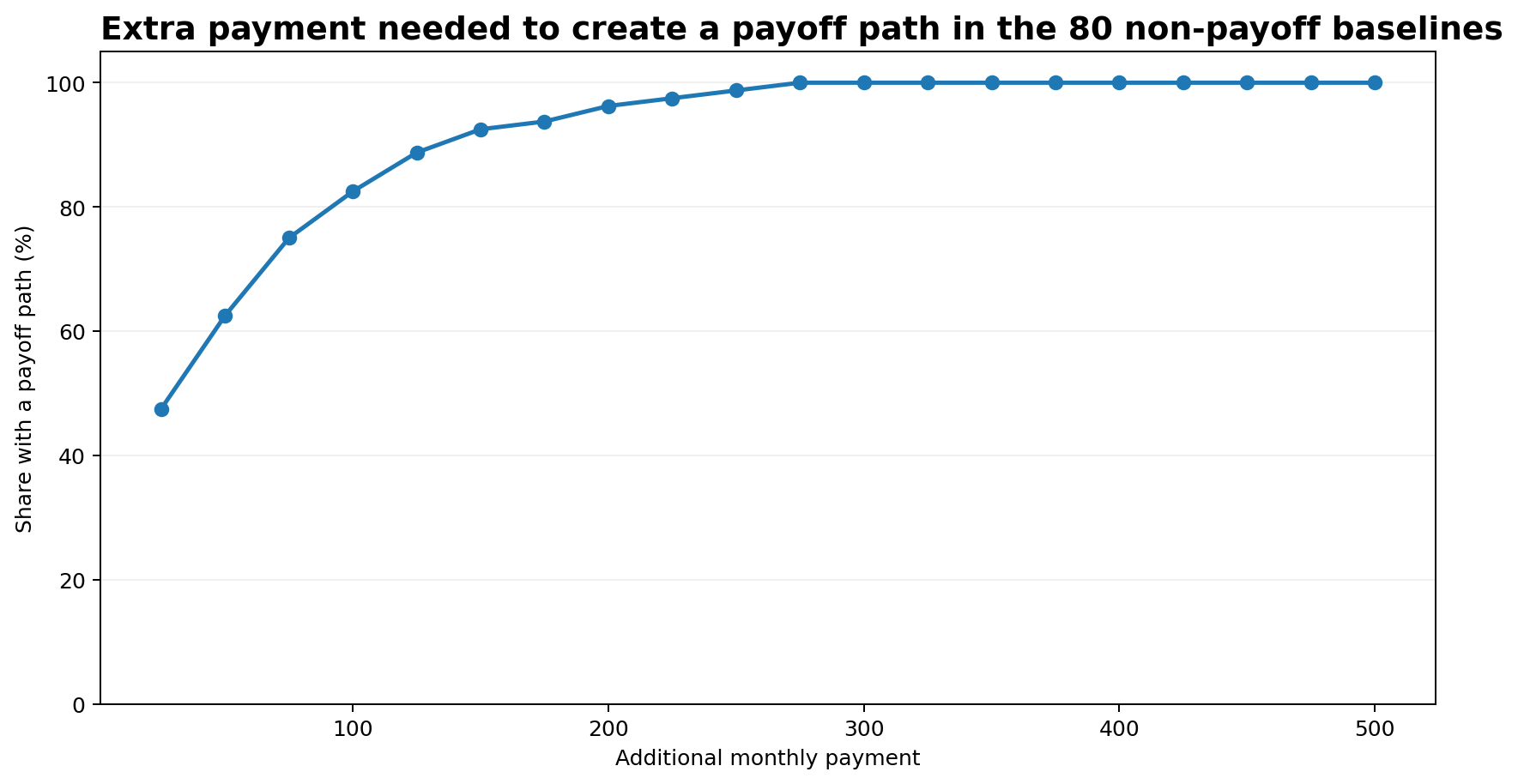
Eighty of the 600 baseline profiles didn't have a payoff path at the original payment because the rounded monthly interest was at least as large as the fixed payment. An extra $25 established a payoff path in 38 of those 80 profiles. At +$100, 66 had a payoff path. All 80 reached payoff by +$275.
When the baseline doesn't have a finite payoff time or lifetime-interest total, the study leaves months saved, interest saved, and percentage reductions blank. It doesn't substitute the 1,200-month safety horizon as a fake payoff date.
Explore the certified scenario grid
Choose one of the 600 baseline profiles to see all 20 extra-payment comparisons from the published dataset. For values outside this grid, use the Extra Payment Calculator.
| Extra | Total payment |
Payoff time |
Months saved |
Interest | Interest saved |
Time reduction |
Interest reduction |
|---|
Swipe horizontally to compare all columns.
Run your own numbers
Test a payment amount outside the study grid
The research explorer only uses certified study inputs. The calculators support custom balances, APRs, payment amounts, and payoff targets.
Methodology
The study uses an exact-cent fixed-APR payoff engine shared with fixed-payment calculations on the Credit Card Payoff Calculator. All balances, payments, and interest totals are represented at cent precision.
Monthly calculation order
- Start with the beginning balance.
- Calculate monthly interest as beginning balance × APR ÷ 1,200.
- Round that interest to the nearest cent using round-half-up.
- Add interest to the balance.
- Apply the fixed monthly payment.
- Cap the final payment at the amount still owed.
- Repeat until the balance reaches $0 or the path is classified as non-payoff.
Baseline payment
The baseline payment is calculated once from the starting balance: 2%, 2.5%, 3%, 4%, 5%, or 7.5%. It then stays fixed. These are analytical payment rates, not issuer minimum-payment formulas.
Non-payoff handling
If rounded monthly interest is at least as large as the intended payment, the payment doesn't reduce principal under the study rules. That path is classified separately. A principal-reducing path that remains open after 1,200 months is also reported separately.
Percentile bands
The 25th and 75th percentile bands use linear interpolation in the sorted values at position (n − 1) × q. When that position falls between two observations, the percentile is interpolated proportionally between them.
Independent verification
An independent Python Decimal verifier recalculated every payoff path and re-derived all 29 CSV fields across the complete 12,000-row dataset, including savings, percentage reductions, comparison classes, and marginal $25 results. It also checked the identifiers, version metadata, and full scenario grid. The verification report found zero discrepancies.
Limitations
- The APR stays fixed throughout each payoff path.
- No new purchases, cash advances, fees, missed payments, promotional rates, or penalty APRs are added.
- The study uses monthly APR ÷ 12 interest. Real card issuers may use daily periodic rates and statement-specific balance methods.
- The baseline payment stays fixed. It isn't a declining issuer minimum payment.
- The grid is equally weighted and doesn't estimate the distribution of real consumer balances, APRs, or payments.
- A result from a defined scenario is a calculation under the stated assumptions, not a prediction of a specific cardholder's statement activity.
Download the research data
The public package includes the full comparison dataset, machine-readable methodology, independent calculation-verification report, and checksums.
Research files
Reproduce or cite the study
Debt Payoff Planner
Turn a one-time comparison into an active payoff plan
Compare strategies, add recurring or one-time extra payments, project cash flow, and track progress as balances change.
Extra-payment research FAQ
How much did an extra $25 change payoff time?
Among the 520 baseline profiles that already reached payoff, +$25 reduced median payoff time by 3.5 months and median interest by $295.05.
Why don't the 80 non-payoff baselines have months-saved percentages?
The original payment doesn't produce a finite payoff time or lifetime-interest total in those profiles. The study reports when a higher payment establishes a payoff path without assigning a made-up baseline duration.
Does each new $25 save the same amount?
No. Cumulative savings keep rising, while median incremental interest savings from each individual $25 step fall as the balance is retired faster.
Can I use a payment amount that isn't in the study?
Yes. Use the Extra Payment Calculator for custom values. The explorer on this page stays tied to the certified 600-profile research grid.